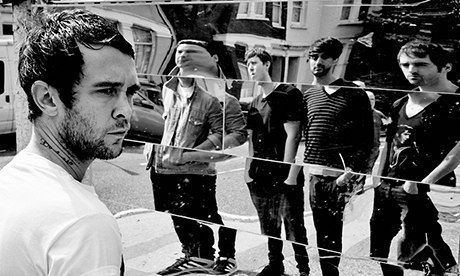
Bipolar Sunshine

Bipolar Sunshine

Ex-Kid British boy wonder turned solo hybrid of the Streets and Blur.

Hometown: Manchester.

The lineup: Adio Marchant (vocals, music).

The background: You could call it a case of every dog having his day, or simply just reward for (dogged) persistence, but anyway, here comes Bipolar Sunshine, the second appearance in this column for Adio Marchant, former frontman with Manchester almost-rans Kid British. The fact that he’s now operating as Bipolar Sunshine perhaps offers some clues as to why Kid British didn’t work out. His is a rather bleak, contrary vision, and although more often than not he frames his mordant worldview within upbeat settings, he’s clearly a character who is deeply affected by relationships, circumstances and his surroundings. He’s quite possibly hard work, but at least it means he gets the results he wants.

It also means he can be a bit perplexing. We’ve actually put off writing about him since his summer debut EP Aesthetics, mainly because we didn’t know how to pitch him to you, so god knows how he’d market himself to a record label. He seems to relish the confusion he causes. He’s even got a song called Trouble in which he admits, «I know you’re trouble and I like it – because you know I’m trouble, too. It takes one to know one!»

Reading on mobile? Click here to listen

So we know who he is – a Mancunian twentysomething with a background in bands. But what is Bipolar Sunshine? Good question. He’s a (deep breath) rapping, singing indie-rocker with a penchant for gospel, soul and pop kind of guy. A Mike Skinner/Damon Albarn hybrid. You can hear for yourself on his latest EP, Drowning Butterflies, and maybe you will have seen/will see for yourself on his various support slots with Haim, Bastille, Rudimental and Phoenix. He’s had a lot of the treatment you would expect from a new(ish) artist with talent and promise – plays on all the right radio shows (the Zanes and Huws) and all the right blogs, including Fader, This Is Fake DIY, Pigeons and Planes and more, who have proclaimed him the future of jaunty, poetic miserablism.

Advertisement

Marchant’s own intention is modest: «to move away from what people still perceive as Manchester music.» Job done, really, because he doesn’t sound like anyone Manc past or present. That’s not to say he’s utterly original, just that he doesn’t evoke any specific artist from the city. He’s a fan of everyone from Arctic Monkeys to Kanye and Kendrick and he grew up listening to the Carpenters and the Smiths, but you can’t really tell. He has yet to magic a composition informed by, say, Goodbye to Love and How Soon Is Now, although we breathlessly await that moment. But meanwhile he has given us: Love More, Worry Less that recalls Blur’s Tender sung by a latterday Bill Withers; Rivers which incorporates elements of hip hop, indie and African music; Drowning Butterflies with its reggae lilt; and the synthy atmospherics of Trouble. And he does channel some of Morrissey’s (and Richard Carpenter’s) epic melancholy, with lyrics that reflect his anguish about «pain and lust» and his desire to escape the mundanity of relationships even as they draw him in. If he carries on like this, we’d gladly feature him in a third guise.

The buzz: «Primed for big things» – Fader.

The truth: You’ll be confused, but in a good way.

Most likely to: Morph.

Least likely to: Sink.

What to buy: The Drowning Butterflies EP is out now.

File next to: Damon Albarn, Mike Skinner, Sampha, King Krule.

Links: bipolarsunshine.com.

Rainer

Rainer-008

Hometown: London.

The lineup: Rebekah Raa (vocals), Nic Nell (music).

The background: This year’s BBC Sound Of… poll has had the usual mixed reaction. We think it’s a pretty strong lineup, even if just on the basis of FKA Twigs and Kelela, but there’s also Say Lou Lou and MNEK, Jungle and Sampha, Chance the Rapper and Luke Sital-Singh… It’s a good list. But already, we’re wondering: what about such-and-such? And how could they have left out so-and-so?

Today’s new band really feel like a glaring omission. Some of their stuff is stunning. They’re a duo with shades of other two-pieces such as Ms Mr and Iyes, the music not a million miles from Kelela’s out-there R&B team-ups with the Night Slugs people, mixed with a Scandinavian quirk-pop sensibility. They comprise Rebekah Raa (formerly Stricken City) and Nic Nell (his producer name is Casually Here and he’s one half of Young Colossus with the Maccabees’ Orlando Weeks) and they’ve released a double A-side, Girls/Money, and an EP entitled Hope/Satin/Glass/Dreams. They call themselves «pop satirists» and the way Rebekah Raa sings (deceptively sweetly) and casts a critical eye over the culture – not to mention her breathily casual enunciation of the phrase «fuck this shit» on Girls – bears comparison with Lorde. They admit to loving the sheer expensive bigness of (North) American pop productions from R Kelly to Miley to the Weeknd while also paying attention to Rinse FM and Reprezent and the forlorn «nightbus» electronicscapes and post-garage chart sounds that have emerged out of that world from AlunaGeorge to Burial to Disclosure.

Reading on mobile? Click here to listen

Lyrical influences include «altered states of mind and strange conversations» and the «scary but exhilarating nature of sex» and subject matter ranges from «happiness to neediness, melancholy to insanity». As for Nell, he writes the music either following a spell in a sensory deprivation flotation tank or just before losing consciousness «in that weird border state between being awake and sleep». The results are intoxicating. Money, notwithstanding that «fuck this shit», has a melodic loveliness that contrasts with the tart irascibility of the lyric, but with some deft censorship (as per the Vamps and Icona Pop) it could do the biz. Rainer’s X-factored lyrics might be the only thing standing between them and daytime radio playlists: Satin («I’m out having fun here on my own») is an ode to listless masturbation; «about telling your boy to come home from that party he shouldn’t be at because you’re pretty much naked and waiting for him.» Swallow («I feel vulnerable… this is a delicate time. I’m buried alive!») appears to be about oral sex. A bleep here and a cut there and… they’re a hit.

Sampha

Sampha

He’s the new piano man with the husky voice whose stark confessionals have made him the go-to balladeer for hip hoppers and dubsteppers.

Hometown: Morden, South London.

The lineup: Sampha Sisay (music, production).

The background: Sampha first made a cameo in this column in 2010 in an article on rapper Dels, the year he released his first EP, Sundanza. Since then, the pianist, producer and electronic music singer-songwriter has worked with SBTRKT and Solange Knowles, Koreless and Lil Silva, Jessie Ware – on her 2011 track Valentine – and Drake, producing and singing on two tracks from the Nothing Was the Same album: the Motion and Too Much. And now the 24-year-old Londoner is preparing to step out of the collaborative shadows, into the solo limelight, with his latest single, an iteration of Too Much b/w Happens, and we say b/w because it’s being issued as a 7″ vinyl single in January.
Reading on mobile? Click here to listen

Advertisement

«Electronic music singer-songwriter»? That’s how he’s been pitched and that’s the world he operates in. But in a way he’s more Elton John than James Blake. Or at least, an Elton John under the sway of Malian singer Oumou Sangaré, whose idiosyncratic melodies and scales had such an impact on the young musician. In a way he sounds like an unelectronic James Blake, where the dubstep influence is implied rather than pervasive. The music is very spartan – often just piano (not synth) and voice. The spaciousness suggests loneliness and the crepuscular atmosphere evokes the feelings of sorrow and pain that informed it: his father passed away when he was nine and that loss – his absence – is a kind of leitmotif in his songs. On last year’s Dual EP and the new single Sampha seems to be exploring the dark terrain between attachment and emotional distance (there’s even a track entitled Can’t Get Close, and another called Demons), and if that sounds heavy and portentous, so is Sampha’s music, in a good way.

He’s not exactly – or even remotely – one of those post-Weeknd types where the voice and music are integrated skilfully. No, with Sampha the vocal is starkly separated from the spare accompaniment, to the extent that it either sounds utterly new, or weirdly old-fashioned and pre-postmodern. Happens features a voice and some piano trills, and that’s it. Too Much is equally heartfelt and unadorned – one wonders how exposed he felt singing it on US TV show Late Night with Jimmy Fallon recently. Indecision – written around the time of Amy Winehouse’s death, apparently – is typical Sampha in its lack of melodic obviousness. «It’s slightly about myself but more about someone who has problems; fundamental issues,» he told Pitchfork. But the real issue is whether Sampha can make his bleak confessionals and anguished character studies relatable to the wider public.

The buzz: «Sampha Sisay has a quiet way about him. It’s what makes the raw emotion that spills out of him all the more startling» – Pitchfork.

The truth: He’s more Elton John than James Blake.

Most likely to: Happen.

Least likely to: Be too much.

What to buy: Too Much / Happens is out now on Young Turks. The 7″ vinyl follows on January 6.

File next to: James Blake, Jamie Woon, Elton John, Oumou Sangaré.

Links: sampha.com.

Wednesday’s new band: Rainer.

Royal Blood

Royal Blood

Buzzworthy Brightonians channelling Zep and Pixies using the tried-and-tested two-piece format.

Hometown: Brighton.

The lineup: Mike Kerr (vocals, bass), Ben Thatcher (drums).

The background: Although Drenge, Southern, Ruen Brothers and now Royal Blood have their own specialisms and idiosyncrasies, it would be hard to argue that they weren’t born out of an idea first formulated by the White Stripes. Before them, the two-piece was a unit of musical expression generally utilised by electronic pop acts: Yazoo, Soft Cell, Blancmange, OMD, Pet Shop Boys, and so on. It’s the same today, from Sleigh Bells to Wilde Belle. But the rock duo is new. Feel absolutely free to disabuse us of this, but we can’t remember a single example before Jack and Meg.

So anyway, Royal Blood are the latest exponents of this form, but if you were expecting that to mean they would seem like the umpteenth iteration, even though they are (see also: Black Keys, Deap Vally, the Pack AD), you’d be wrong. Two lads from Brighton, much loved of Arctic Monkeys’ Matt Helders (he was seen wearing a Royal Blood T-shirt onstage at Glastonbury), they make one hell of a racket considering their arsenal comprises a bass, a voice and a guitar. But it isn’t just noise, there is nuance here, which makes it all the more powerful, as well as intricacy and invention. It’s like being hit by the hammer of the gods, only wielded with skill.

Reading on mobile? Click here to listen

You can hear echoes and tremors of Led Zeppelin in the mighty wallop of early 2013 track Figure It Out. Mike Kerr wrings every ounce of feeling out of his voice as it moves from a controlled mid-range tenor to an excitable near-shriek. And is that really just a bass making all that sound, or rather, all those sounds? Meanwhile, Ben Thatcher does more than keep time. You might say he extends time, or stops time. It’s riveting stuff. Debut single Out of the Black, just released, registers even higher on rock’s richter scale. Blues is clearly the root of it all, but it’s all in the electrification. That, and the use of the voice as an instrument of retribution («Don’t breathe when I’m talking because you haven’t been spoken to!») and the bass as guitar (and bass). Importantly, it sounds authentic, although authentic to what? To four long-haired Midlanders called Plant, Page, Bonham and Jones? Kerr sings in American, that’s for sure. «You made a fool out of me, took the skin off my back, honey.» He’s got the blues, singing – wailing, really – about «the vows we made». It is testament to the great music that can emerge from a routinely damaged relationship between two people, any people. B-side Come On Over channels Zep via the Pixies. Even after all these years, the right riff can – to use a technical term – cave your head in. There would appear to be no limitations as yet with regard to what these two musicians can achieve as long as they stick within the parameters of what they seem to want to do, which is, largely speaking, to make simply thrilling rock’n’roll and blow away festival crowds next summer.

Lolawolf

Lolawolf

Jim Hendrix impersonator sires 80s NYC disco-pop wild child. Are you gonna go her way?

Hometown: Brooklyn.

The lineup: Zoe Kravitz, James Levy, Raviv Ullman, Jimmy Giannopoulos.

The background: «Would you take me to the West Side – would that be alright?» Zoë Kravitz ever so politely enquires on Drive, the lead track on Lolawolf’s debut EP, released in January 2014. What will she do when she gets there, we hear you ask. «I could stare out your window,» she coos, then pauses for dramatic effect, «and fuck you tonight.» Okaaay. Wonder what her dad makes of that. Turns out her old man is Lenny Kravitz, if that makes a difference. Probably not. Bad language and rapacious desire must be hard to swallow, never mind whose daughter you are. But still, that’s Kravitz (Zoë, not Lenny) for you: she plays it sassy with her band Lolawolf, who come dressed in sweet (sheep’s) clothing, so watch out. This is sugar pop with R&B flavours and a switchblade under the strawberry candy carapace. She’s backed, not by sessioneers but the band Reputante (who are signed to Julian Casablancas’ label) and they look like Bowery bums straight outta New York back when Lou Reed was getting – or giving – street hassle. Think Solange if she joined the Strokes and they finished that album of Quincy Jones-produced pop they were once rumoured to be making. It’s indie, but since when did that stop certain people crossing over into the real charts? As Pitchfork said: «Drive strikes the balance of Chromatics’ bleary synth-driven brightness and Lana Del Rey’s detached-yet-dramatised longing.» We don’t even know who Chromatics are, but it still confirms our point.

Reading on mobile? Click here to listen

Zoë, also an actress, was playing an anorexic in a film called the Road Within, as you do, down to 90lbs, an emotional and physical wreck, going out of her tiny (actually sizeable) mind. Suddenly, Lolawolf hoved into view and saved her. «Music was like my therapy,» she says. She drew on Fiona Apple and No Doubt – not that you can tell. Influence-wise, we can hear early Madonna, 80s new wave/synthpop and high-sucrose R&B from any era. Drive is pure Lana del Lennox (they love the Eurythmics) with a surging chorus: this is definitely one of the better examples of the scions-of-stars genus. The titles alone reek of 80s goodness: Drive, What Love Is, Wanna Have Fun – just watch the Cars, Tina Turner/Foreigner and Cyndi Lauper sit up and beg. Not that they’re cover versions, but the component parts, from instruments to lyrics, suggest a thorough immersion in the period. What Love Is is cute yet cutting («Why can’t I be faithful?»), the sort of pretty but playful pop you might have thought they didn’t make anymore. «I like it when a song sounds happy and makes you want to dance, and then when you listen to the lyrics, they’re kind of fucked up,» she says. Wanna Have Fun – about a threesome gone wrong – slides along seductively, with languor to spare. Give Me More is like Little Boots if she was a badass from the Bronx. Chainz is wild. Kim Wilde. She’s a kid (well, she’s 24) in America, getting into the groove, dodging preconceptions – «I represent, to some people, this socialite-y, fashion-y, bitch girl and that’s not at all who I am» – and looking for new ways to outdo her guitar-shagging dear old dad.

Naked (On Drugs)

Naked (On Drugs)

Franco-Manc duo with an artful combination of sleaze and menace.

Hometown: Manchester.

The lineup: Sebastien Perrin (vocals), Luke Byron Scott (guitar).

The background: There’s a photo of today’s new duo, naked, although whether they’re on drugs we can’t tell. We can tell, however, that the photo of them was taken in the bath, which is fitting because they actually sound dirty, not to mention look it. Seedy, unsavoury. Like they’ve been living in grim bedsits and doing unseemly things in dank cellars. Put it this way: you wouldn’t allow your daughter to spend more than five minutes with them any more than you would permit them to, say, marry a Rolling Stone.

They’re handsome devils, these Mancunian boys, which adds to their threat. Actually, they came from Lyon and Milton Keynes to bring a sense of boho art sleaze to the city. It’s not a very Manc noise they make – no pristine machine disco for them, and they don’t do lad indie. Instead, they plough a (dingy, dark) furrow started by the Doors and continued by everyone from the Bunnymen to the Bad Seeds, with vocals that mix the poetic baritone with elements of menace and mischief. Expect not just rock but swathes of Eastern European folk on their debut single Lee Ann’s Skin / Araki Dinosaurs, parts of which sound a bit like Scott Walker ODing on klezmer.

Reading on mobile? Click here to listen

It’s a great single, even if it might leave you feeling a little grubby. Lee Ann’s Skin opens with double bass, pure chamber baroque, before shifting gear and moving at a Killing Moon pace, with twangy C&W guitar, sobbing violin and eerie effects to sustain your interest if that voice on its own doesn’t do the trick, although it should – it is sleazoid charm personified. The voice takes a turn for the weird on Araki Dinosaurs. Over a tinny pulse reminiscent of Suicide, our dodgy heroes croon like Dalek lotharios, either about «soccer moms» or advising their prey to «suck your mouths» – apologies, we don’t speak skaro. It’s blues, Jim (Morrison), but not as we know it, unless someone has already made a record fusing cyber-Beefheart growls, handclaps, an askew jig and the frantic hiss of circuitry and we missed it? From its title we were expecting Death Dance to be an unsightly hybrid of Dance Stance and Death Disco and it’s only slightly less misshapen than that, all clarinet blasts over percussion that sounds like the kitchen synched to a dancing robot and lyrics about snapping someone’s neck. They should never have got out the bath.

Michael A Grammar

Michael A Grammar

New Midlands band channelling Madchester via the Thames Valley.

Hometown: Nottingham.

The lineup: Frankie Mockett (guitar, vocals), Joel Sayers (guitar, vocals), Daniel Ondieki (bass), John Davies (drums).

The background: Michael A Grammar are like a Manchester band doing an impression of a Thames Valley one; a hybrid of baggy and shoegaze. That’s not as curdling a concoction as it might sound: both musics, after all, had as their goal bliss-out and sweet surrender. But it’s true: listening to tracks from their Vitamin Easy EP and forthcoming single the Day I Come Alive is like hearing what might have occurred had the Stone Roses decamped to Reading in 1991 for a stoned session with Slowdive. We’re talking ambient noise-pop heavy on hazy atmospherics, with the slow-motion momentum of a krautrock band drifting listlessly on the autobahn (sorry, M6 and M40). Narcotic yet nice, would be our opening marketing gambit.

Reading on mobile? Click here to listen

They’re named after a song by Birmingham electronicists Broadcast and they’re from Brighton originally but live in Nottingham and record for a Manchester-based label. Pass the SatNav. They recorded their Vitamin Easy EP in a haunted Victorian coach-house in the East Midlands, and you can sort of tell. There is so much echo there is hardly room for all the delay. Eerie atmospherica your chosen tipple? You need Michael A Grammar. All Night, Afloat has a motorik charge, with a chant of a chorus, although this is far from the yob-stomp of yesterday’s new band IC1s. The treated vocal is interesting – half in-its-own-world, half a tool for mass communication. The guitars, too, shimmer experimentally while clamouring for attention. The guitars on Light of a Darkness have a country and western twang – think Joy Division in Texas. Upside Down sets the controls for sun-dappled and brings to mind Brian Eno if he was an indie band. On King and Barnes the singer has the stoned baritone of Ian Brown doing an impression of Ian Curtis. The newest track, the Day I Come Alive, is their best to date, a break from their slothful shimmer, more fully realised, closer to a proper single than anything they’ve yet recorded, with a radiant starglow of a chorus, or an effulgent rainburst – something dazzling and elemental, anyway. At times like these, you think, they’re gonna be adored.

IC1s

IC1s

These Harrow lads make music for terraces, in the yob-anthem vein of Sham 69 (with a little U2 guitar)

Hometown: Harrow.

The lineup: Daniel Coburn (vocals), Jesse James (guitars), John Campbell (guitars), Leon Dee (bass), Andy Faulkner (drums).

The background: They headlined HMV’s Next Big Thing Festival and played on the Emerging Icons Festival Stage at last year’s Olympics. Gary Powell of the Libertines has been championing them, as has NME, describing them as «a proper, no-messing-about, rock’n’roll rock band.» Artrocker has hailed them as harbingers of a return to the glory days of indie anthemia while Alan McGee has called them «brilliant» and «post-everything».

Reading between the lines there, you might be able to work out that IC1s, a new-ish five-piece from Harrow, hotbed of revolutionary rock action, are not a confounding hybrid of Aphex Twin and Abba. A recommendation by a Libertine, the phrase «no-messing-about», a big-up from McGee, who as we recall said something similar about 3 Colours Red… Yes, we are in the terrain of the bog-standard rock band chasing last-gang-in-town status, with a gruff-voiced frontman harbouring delusions of soulfulness and the ambition of his mouthy ’90s forebears. In one pithy sentence he conflates footie and indie in a way that immediately recalls the Britpop lads. «The whole music scene is crying out for us,» says Daniel Coburn, adding: «I wanna be the biggest band in the world. If you’re gonna be a football team you wanna be Barcelona.»

Reading on mobile? Click here to listen

They’re not so much Lionel Messi as a bit messy. Their gigs are chaotic, all fist-punching fervour and stage-invading sweat, and they’re midway between the do-gooder activism of the defunct King Blues and the terrace-chant stomps of Oi! bands such as the Cockney Rejects and Angelic Upstarts. They’ve already titled their 2014 debut album Lowering The Tone – «because we’re all cheeky chappies, we do lower the tone» – which they’ve recorded with producer Barny (Arctic Monkeys, Kasabian) Barnicott. «It’s about a working class upbringing,» Coburn explains. «It’s about getting pissed with your mates in the park with a bottle of mad dog 20/20, and at the end of it it’s about looking back and wishing you could have done more. It’s hug-a-stranger, pint-in-the-air kind of stuff.»

Oh dear, yes, it probably is. Beautiful Ugly, which may be on the album, is music for people who think Stereophonics are a bit avant-garde, sung in a voice that some will describe as soulful, others as a bellowing signifier of wretched self-devotion. Levitate sounds like Dreaming by Blondie, only played by builders. Coburn appears to be projecting to a big audience and it would be disconcerting to see him singing in this way, backed by that sound, in a small venue – which you could have done last night had you caught them at Heaven in London, although it was some way from our conception of nirvana. Growing Up, Going Down – «a tale of small-town frustration» (what? Harrow’s only 20 minutes on the Met line from Baker Street) – will be, for some, pure surging insurrection and poetic anger on the streets. Not Perfect reminds us of bands like the Levellers, bands we would never want to hear, although there is a ringing, resonant quality to the guitar that suggests early U2. We must confess, we do have a soft spot for Whack Jack, a croaky Cockney knees-up worthy of Sham 69 whose chorus – «I’m a little bit kooky, a little bit mental, a little bit experimental» – would work in either soccer or playgrounds this Christmas. In fact, were it not a song about stalkers, it could conceivably headbutt the hit parade. But if we had to listen to any more than that one track we’d feel like doing the same to the wall.

Air Traffic Controller

Air Traffic Controller

Quirkily infectious geek-pop from the States. Prediction: they might be giants.

Hometown: Boston, USA.

The lineup: Dave Munro (lead vocals, acoustic and electric guitar), Richie Munro (drums), Steve Scott (keyboards, effects, electric guitar), Casey Sullivan (lead vocals, bass, mandolin), Kiara Ana (viola).

The background: Air Traffic Controller are one of those bands where it’s really an outlet for the frontman and the others are just there to realise his grandiose/madcap schemes. They’re a solo act in all but name, which isn’t to disparage the other musicians involved, because they do a fine job of turning what might have been tedious acoustic ditties from the nerd-megalomaniac in question – Dave Munro – into fully arranged, and sometimes orchestrally overblown (in a good way), paeans to baroque self-absorption.

Munro was a real-life air traffic controller for the US Navy – true story, apparently – only instead of focusing on the job at hand, i.e. making sure the planes didn’t go careening into the hull of his ship, he spent long hours poring over the minutiae of his past and present romantic liaisons. And so he wrote an album called Nordo. Now, Nordo refers to aircraft that experience radio failure while flying. And if you can decipher what the meaning behind that little metaphor might be vis a vis interpersonal relations, you’re more insightful than us (not difficult, admittedly). Suffice to say we’re imagining that crashing and burning are probably involved, unless that’s just us casting back to our first marriage, which we do a lot.

Reading on mobile? Click here to listen

Not that Nordo is heavy-going or takes effort to enjoy. Far from it. In fact, it’s a delight almost from end to end, and one can’t help wondering what a record company push over here might achieve (we’re told legions of A&R ladies and gentlemen are already queuing up for their London gig on Tuesday, although it is a tiny venue). Is there a market for upbeat geek-indie-pop with rhythms and melodies so finger-clickingly good you keep Googling that they weren’t already hits from 1986 or featured in a Brat Pack movie scene in which Molly Ringwald jitterbugs in an ironic mid-’80s homage to the original rock’n’roll era? Munro might sing «I’m so miserable» but he’s no US Morrissey – or rather, he is, which means he’s got Hollywood in his blood and he can’t resist allying his every solipsistic aphorism and wry miserablism to the jauntiest power pop this side of the Knack’s My Sharona, all handclaps and woah-ohs. It’s orch-pop for the emotionally challenged, and unashamed with it. Pretty much anywhere you alight on the album you get something good, if you like this sort of thing. «Listen to me: do I sound happy?» Munro sings in his high, keening tenor. To be honest: in your own happy-when-it-rains way, yes. Upbeat despair: yum, our favourite. What can we say? Another One to Watch for 2014. Our shortlist currently contains about 117 names. But hey, that’s us. We’re picky.

The Moth and the Flame

The Moth and the Flame
Indie rock that is dour yet dazzling, from the home of Donny and Marie.

Hometown: Provo, Utah.

The lineup: Brandon Robbins (vocals, guitar), Mark Garbett (keyboards, vocals), Andrew Tolman (backing vocals, drums).

The background: The Moth and the Flame are fulfilling a need, if indeed such a demand exists, for a Coldplay/Flaming Lips hybrid. They’re an LA-based three-piece who started out in Provo, Utah, home of Donny and Marie Osmond, which suggests a hybrid for which there is definitely no demand. There are two releases out there for your consideration: the two-year-old self-titled debut album, which was engineered by Mike (Skrillex, Deadmau5) Roskelley but you can’t really tell, deficient as it is in ear-punishing brostep; and the new EP, &, which was produced by Joey (Beck, R.E.M.) Waronker, whose imprint is probably more evident than Roskelley’s. They will have a second album proper, and first internationally distributed one, in 2014 – they are currently working on it with producer/mixer Peter (Interpol, the National) Katis, with string arrangements courtesy Rob Moose (Bon Iver, Sufjan Stevens). The bracketed artists in the latter two instances also have a bearing on the Moth and the Flame’s sound: it is lush, layered, often complex indie that references the last decade’s big boys of alternative rock: Coldplay, Radiohead and the Lips, with some nods to U2 at their more experimental.

Reading on mobile? Click here to listen

Their newer music evinces a sizable leap in terms of sonics and dynamics. Sorry, from the EP, is as brilliant as Flaming Lips, by which we mean it has the brightness, the sheer surface dazzle, of the Lips’ best music. There is a forward momentum to the track that is compelling, and the singer’s voice moves from mid-register to falsetto, the general sense of the lyrics shifting as it does. «Sorry for everything I’ve done,» he wails, something we say every morning to Mrs NBOTD. Winsome is percussive indie-dance, a bit like U2 when they Went Techno. Again, the music has an impressive rhythmical thrust (as Mrs NBOTD fails to say to us every night) while Brandon Robbins channels his inner Bono, only Bono when he’s trying to be cool and enigmatic, not a bellowing, pompous ass. Silver Tongue flits from psych to prog to grunge while Holy War – two minutes of shimmering keyboard chords, with the words «There’s a holy war in your life» repeated many (many) times – locates the middle ground between the serious/dour and the whimsical/cosmic. How We Woke Up also recalls U2 or Radiohead at their sincerest and most «meaningful»: this is trad indie with Big Rock Venue appeal and some play regarding dynamics and use of electronics. TMATF bring a similar sense of play to the promotion of their music. That debut album came out in the States on 11/11/11. For it, the band created 20ft anthropomorphic artwork which they placed strategically throughout their home town. Rumours that Donny and Marie reacted by going on a Mormon rampage are unfounded.